Sunlight Through Leaves Has a Name in Japan — and It Might Explain Why You Can't Stop Chasing That Shot
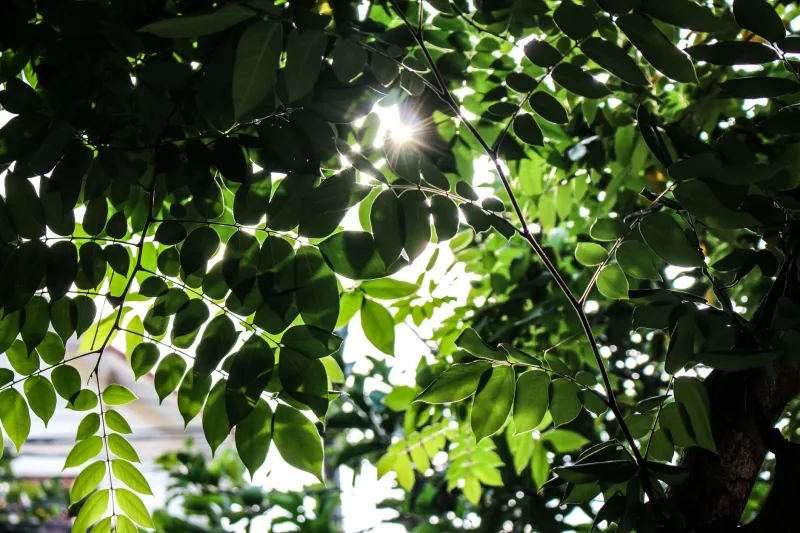
You know the moment. You're walking through a park — maybe it's Prospect Park in Brooklyn, or a trail somewhere in the Cascades, or even just the tree-lined street outside your apartment — and the light does that thing. It breaks apart through the leaves overhead, scattering into soft, shifting patches on the ground. You stop. You pull out your phone. You try to capture it, and somehow the photo never quite does it justice.
In Japan, that exact moment has a name: komorebi (木漏れ日).
The word is built from three kanji — tree, escape or leak, and sun — and together they describe something specific and deeply felt: the interplay of sunlight and leaves, the way light doesn't just pass through a forest but gets caught, filtered, and scattered into something almost alive. It's not just a meteorological observation. It's a recognition that this particular quality of light is worth noticing, worth naming, worth sitting with.
And apparently, Americans agree — even if most of us didn't have the word for it until recently.
Why This Word Is Having a Moment
Komorebi has been quietly circulating in wellness circles, photography communities, and lifestyle blogs for a few years now. It shows up on Pinterest boards labeled "forest bathing" and in Instagram captions from hikers and nature photographers. It's the kind of word that, once you hear it, makes you feel like something previously unnamed in your own experience has finally been acknowledged.
That recognition isn't an accident. American culture has spent the last decade in a complicated relationship with nature — simultaneously craving it and struggling to actually slow down enough to experience it. We've turned hiking into a fitness metric. We've gamified outdoor exploration with apps that track miles and elevation gain. We've made "getting outside" into yet another item on the self-optimization checklist.
Komorebi doesn't fit neatly into any of that. You can't optimize your way into noticing it. You can't schedule it. It just happens, and the only thing required of you is to be present enough to catch it.
Maybe that's exactly why it resonates.
Japan's Long Relationship With Fleeting Beauty
The Japanese aesthetic tradition has always had a sophisticated vocabulary for transience. The concept of mono no aware — often translated as "the pathos of things" — describes a gentle, bittersweet awareness of impermanence. Cherry blossoms are the classic example: their beauty is inseparable from the fact that they fall within days. The fleeting nature isn't a flaw. It's the whole point.
Komorebi fits squarely into that tradition. The light filtering through leaves is never exactly the same twice. It shifts with the wind, changes with the angle of the sun, disappears the moment clouds roll in. Naming it isn't an attempt to hold onto it. It's more like an acknowledgment — a small bow in the direction of something beautiful that you know won't last.
This stands in pretty sharp contrast to how American culture tends to approach beautiful experiences. We photograph them. We post them. We try to preserve and share and collect them. There's nothing inherently wrong with any of that, but there's something worth examining in the impulse to immediately translate an experience into content. Komorebi asks you to just... be in it for a second.
The Photography Paradox
Here's the irony: komorebi has become enormously popular as a photography subject. Search the hashtag and you'll find thousands of gorgeous images — golden light streaming through redwoods, dappled patterns on mossy forest floors, that magical hour when everything seems to glow from the inside.
And yet the original concept is almost anti-photographic in spirit. The kanji for "escape" or "leak" is key — this is light that slips through, that can't quite be contained. Every photographer who has tried to capture komorebi knows the frustration: the camera sees it differently than the eye does. The dynamic range is wrong. The motion blur misrepresents it. The stillness of a photo can't communicate the way the light moves.
That gap between the experience and the image might actually be the most honest thing about komorebi. It's a reminder that some moments are primarily for living, not documenting. The attempt to capture it isn't wrong — it's human — but the lesson might be in recognizing what the photo can't hold.
Bringing It Into Everyday Life
You don't need a Japanese forest or a perfectly timed golden hour to encounter komorebi. It shows up in suburban backyards, through the skylight of a kitchen, in the shadow patterns on a hardwood floor on a Tuesday afternoon. The concept isn't really about location — it's about attention.
In home design and interior styling, there's a growing interest in what you might call "light awareness" — orienting furniture and living spaces to take advantage of natural light at different times of day, using sheer curtains that allow filtered light rather than blocking it entirely, planting trees or shrubs near windows to create that dappled, shifting quality inside the home. Whether people know the word or not, they're chasing the komorebi effect.
It connects, too, to the broader practice of shinrin-yoku — forest bathing — which has gained real traction in the US wellness space. The science supports it: time spent in forested environments measurably reduces cortisol levels and lowers blood pressure. But the Japanese approach to shinrin-yoku isn't about hitting a step count in the woods. It's about sensory immersion. And komorebi is one of the primary sensory experiences that practice invites you to notice.
What We're Actually Chasing
When Americans discover komorebi, there's often a reaction that goes something like: I've felt that my whole life and never had a word for it. That response is worth paying attention to.
It suggests that the experience itself isn't new or foreign — it's deeply human, cross-cultural, available to anyone who has ever stood under a tree on a sunny day. What Japan offers isn't the experience itself but the permission to treat it as significant. To say: this small, fleeting, unproductive moment of light through leaves is worth a word in our language. It matters enough to name.
In a culture that tends to measure the value of experiences by their scale, their shareability, or their contribution to some larger goal, that's actually a radical proposition. The light through the leaves doesn't need to be part of a wellness routine or a hiking achievement or a content calendar. It can just be what it is — beautiful, temporary, and completely sufficient.
Komorebi won't fix your stress levels or reorganize your priorities. But maybe noticing it — really noticing it, even for thirty seconds on your walk to the car — is a small practice in paying attention to the world as it actually is, rather than as you're trying to make it.
Japan figured that out a long time ago. We're still catching up. And honestly? That's okay.